AI can help you produce more words.
That does not mean it can produce your voice.
This matters because a book is not only a collection of useful information. It is a relationship between an author and a reader. The reader needs to feel there is a real person on the other side of the page. A person who has lived something, learned something, made choices and is willing to stand behind the message.
If every sentence is polished until it sounds like everybody else, the book may be clear but forgettable.
I am not against using AI. Used well, it can help you organise ideas, identify gaps, test explanations, compare structures and challenge lazy thinking. It can help you move from a messy pile of notes to a workable manuscript.
But it should support your thinking, not replace it.
The goal is not to prove that you wrote every word without assistance. The goal is to make sure the final book still carries your lived evidence, your judgment and your way of making meaning.
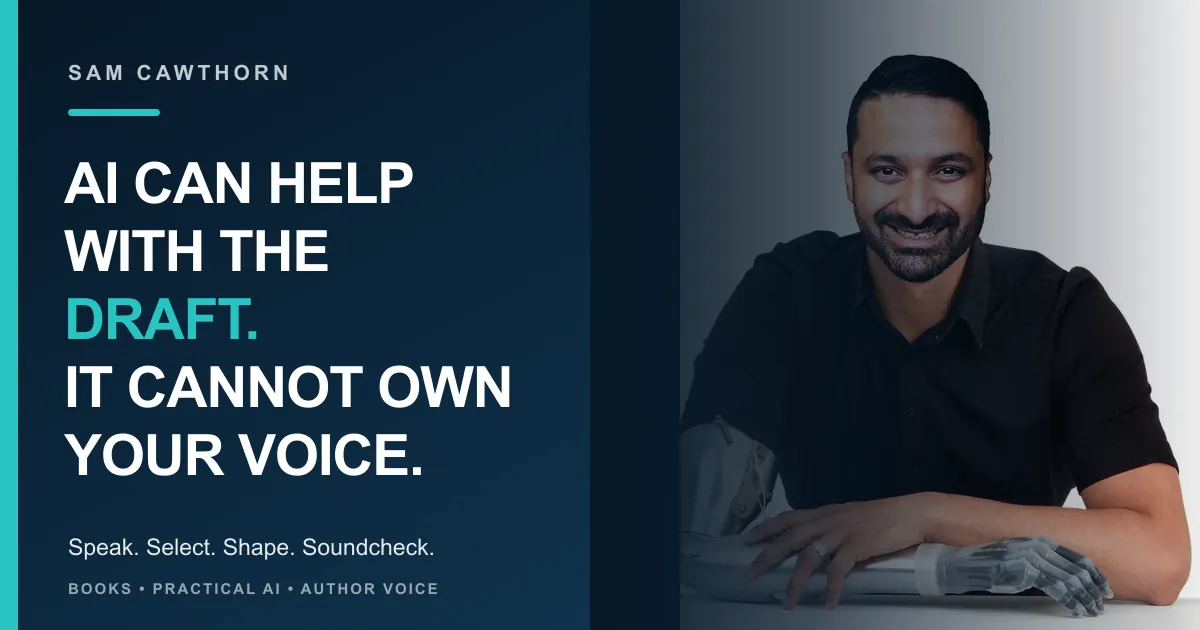
Use four moves: Speak, Select, Shape and Soundcheck.
1. Speak before you polish
Many authors lose their voice because they begin by trying to sound like an author.
They sit down, become formal and write sentences they would never say to another human being. The energy disappears before AI even enters the process.
Start closer to speech.
Explain the idea as if you were helping one person across a table. Record a voice note. Answer a real question from a client, audience member or reader. Tell the story without trying to make it perfect.
Pay attention to the phrases that come naturally. Notice where your energy rises. Notice the examples you use without being prompted. Those are signals of voice.
Your spoken version will probably be untidy. That is fine. Untidy truth is better raw material than polished emptiness.
AI can help transcribe or organise that material. It can group related ideas and show you where you repeat yourself. But begin with language that came through you, not language generated for you.
Before asking AI to draft a chapter, give it your thinking. Share your notes, stories, principles, preferred phrases and the position you want to take. Then treat its output as material to assess, not a finished page to accept.
Your voice has to enter before the polish does.
2. Select the lived evidence only you can bring
Information is easy to generate. Lived evidence is not.
Your reader does not need another chapter made from broad advice that could belong to anyone. They need to know why you believe the idea, where it was tested and what changed your mind.
That does not mean every chapter needs a dramatic personal story. It means the book should contain evidence of a life being lived and a point of view being earned.
Ask:
- What have I seen that shaped this idea?
- What did I believe before experience challenged me?
- Where have I failed, adjusted or changed direction?
- What example makes this principle visible?
- What detail could only come from being there?
This is the heart of Storyshowing. Do not just tell the reader that a principle matters. Help them see the moment, the tension, the choice and the consequence.
AI may help you identify where a chapter feels abstract. It may prompt you to add an example. It cannot decide which memory carries the truth of your message. That judgment belongs to you.
Choose stories because they serve the reader, not because they make you look impressive. Use enough detail to make the lesson real, but protect privacy and do not turn somebody else's experience into your content without permission.
The story is not there to make you the hero. It is there to help the reader recognise themselves and see a possible next step.
3. Shape the idea with your judgment
A clear book needs structure. AI can be useful here.
You can ask it to compare chapter sequences, identify missing transitions, test whether an explanation is understandable or generate questions a sceptical reader might ask.
But structure is not the same as authorship.
The author still has to decide what matters most. What stays? What goes? Which claim is responsible? Which example proves the point? Where does nuance matter more than a neat answer?
This is where many manuscripts become generic. The author accepts the first competent structure because it looks complete. Every chapter has five steps. Every section finishes with an inspiring line. The book is organised, but the thinking has been flattened.
Do not confuse smoothness with strength.
Keep the friction that makes the reader think. Keep the honest sentence that admits the answer depends on context. Keep the conviction that may not fit the most predictable outline.
Use AI to pressure-test your reasoning:
- What assumption am I making here?
- What would a reasonable reader challenge?
- Where am I repeating a familiar idea without adding anything useful?
- What action can the reader take after this section?
Then make the decision yourself.
Your name is on the cover. Your judgment must remain in the work.
4. Soundcheck every chapter
A manuscript can look right on a screen and still sound wrong in a human voice.
Read it aloud.
You will hear the sentences that are too long, the words you would never use and the transitions that feel manufactured. You will notice where the rhythm disappears and where a paragraph is trying too hard to sound important.
Ask one simple question: Would I say this?
If the answer is no, rewrite it.
Then test a second question: Does this sound like the clearest version of me, or just the most familiar version of me?
Voice is not an excuse to avoid editing. A real voice can still be repetitive, vague or confusing. The purpose of editing is not to remove your personality. It is to make your meaning easier to receive.
AI can flag repetition, suggest shorter options and help compare versions. Use it as a rehearsal partner for the page. Keep the choice with the author.
You can also ask a trusted human reader to mark the places where the book feels most like you and the places where it suddenly sounds borrowed. That feedback is valuable because voice is experienced in relationship.
People follow people. Readers do too.
Use the tool without giving away the author
Before you approve a chapter, run this four-part check:
Speak: Did the chapter begin with my real language and thinking?
Select: Does it contain lived evidence, useful detail or a point of view only I can responsibly bring?
Shape: Did I make the important decisions about structure, claims and meaning?
Soundcheck: Have I read it aloud and removed language I would never naturally use?
AI can accelerate parts of the writing process. It can help you face the blank page, organise complexity and test clarity.
It cannot live your story. It cannot carry responsibility for your message. It cannot decide what you are willing to stand for.
A strong book does not need to sound unedited. It needs to sound owned.
Use the tool. Keep the voice. Make every page feel like a real person is speaking to one real reader.
That is how a manuscript becomes more than content.
It becomes a conversation worth continuing.
Writing a book with AI FAQs
How can I use AI to write a book without losing my voice?
Begin with your spoken language, lived evidence and point of view. Use AI to organise, question and refine the material, then make the final decisions yourself and read every chapter aloud.
What should I give AI before asking it to draft a chapter?
Provide your notes, stories, principles, preferred phrases, intended reader and the position you want to take. Treat the output as material to assess rather than a finished page.
How do I know when AI has made my writing sound generic?
Look for language you would never naturally use, overly smooth structures, missing lived detail and claims that no longer show your judgment. If the chapter could belong to anyone, bring your evidence and decisions back into it.
What is the Speak, Select, Shape and Soundcheck framework?
Speak captures your natural language. Select adds lived evidence. Shape keeps your judgment in the structure and claims. Soundcheck tests the finished chapter aloud so it still sounds owned.