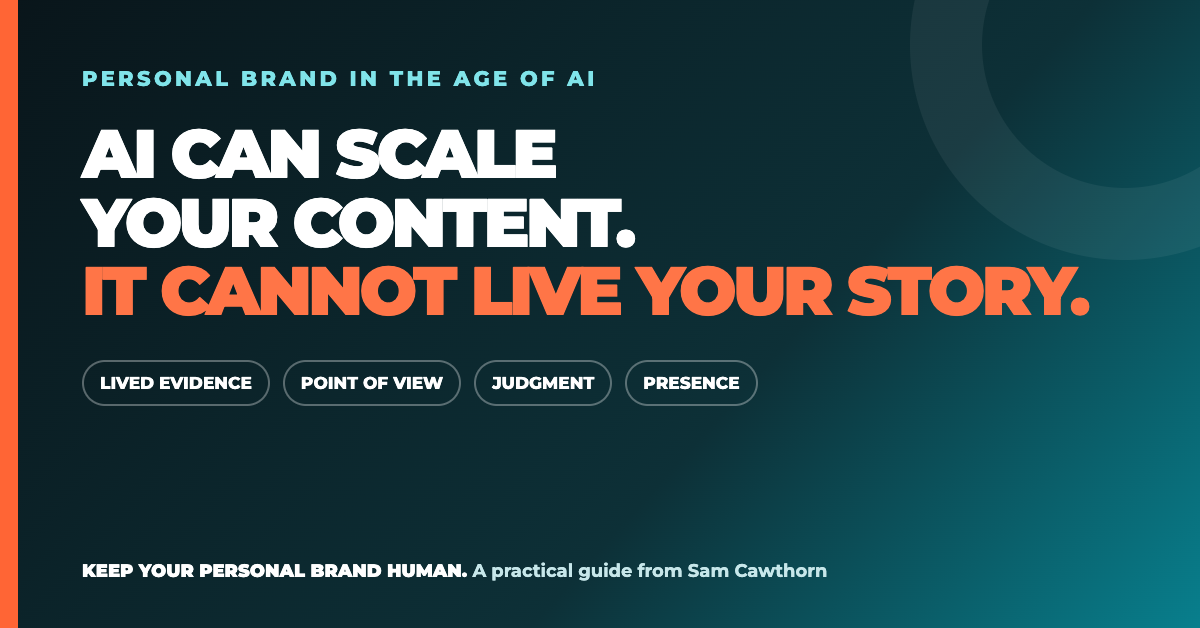
AI can help you produce more words than ever.
That does not mean people will remember any of them.
The real challenge is no longer access to content. It is recognition. When a post, article, email or presentation is polished but could have come from anyone, it does not strengthen your personal brand. It simply adds more noise.
I am not against AI. Used well, it is a practical tool. It can organise thinking, challenge an assumption, suggest questions, tighten a structure and help you prepare.
But your personal brand cannot be outsourced.
Your brand is not your colour palette, your posting frequency or the clever phrase at the top of your profile. It is the expectation people carry about you. It is what they believe you stand for, how you make them feel and what they trust you to help them do.
People Follow People. They do not follow perfect sentences. They follow clarity, conviction, usefulness and character.
If you want to use AI without disappearing inside it, protect four human signals: lived evidence, a clear point of view, visible judgment and real presence.
1. Start with lived evidence
AI can summarise an idea. It cannot live your story.
Your experience gives your message texture. It gives you the moments, decisions, mistakes, observations and lessons that make an idea believable.
That does not mean every post needs a dramatic personal story. It means your thinking should come from somewhere real.
Ask:
- What have I seen that changed my view?
- What mistake taught me this lesson?
- What conversation keeps returning?
- What have I tested in a room, a team or a business?
- What can I describe that a generic answer cannot?
In 2006, a car accident resulted in the amputation of my right arm and a permanent disability in my right leg. I could not simply return to the person I had been. That experience shaped Bounce Forward: the belief that the goal is not to go back, but to use adversity to create a stronger, more intentional future.
The phrase matters because the experience behind it is real. But the message only becomes useful when it helps someone else see their next move.
Use AI after you have named the real lesson, not before. Give it your raw material. Do not ask it to invent the substance.
2. Make a clear point, not a safe summary
AI is very good at giving balanced, reasonable and complete answers.
Personal brands are built when people know what you believe.
A clear point of view does not need to be loud or controversial. It needs to make a choice.
I believe bouncing back is often the wrong goal after disruption. I believe stories should show people what to do, not simply tell them what happened. I believe titles may create authority, but trust creates followership.
Each idea has an edge. It tells you what I am for and what I am challenging.
Before you ask AI to improve a piece of content, write the sentence you are willing to stand behind:
I believe __________ because __________.
Then ask whether the finished content still carries that conviction.
If the words have become smoother but the point has become weaker, the tool has not improved your communication. It has removed your signal.
Your audience does not need every possible perspective in every piece. They need one honest, useful idea that helps them think or act differently.
3. Keep judgment visible
AI can give you options. You are responsible for the choice.
This matters because a personal brand is built as much by what you leave out as what you publish.
You decide whether a claim is true. You decide whether an example is fair. You decide whether a story is yours to share. You decide whether advice fits the audience and whether a confident sentence overpromises the result.
Do not hide behind the tool.
Before you publish, use a simple judgment check:
- True: Can I verify every claim, name and example?
- Mine: Does this reflect what I genuinely believe and understand?
- Useful: Does it help this audience make a better decision or take a practical step?
- Responsible: Am I willing to own the impact of these words?
If the answer is no, revise it or remove it.
Efficiency is valuable, but trust is more valuable. One careless invented detail can damage credibility that took years to build.
Use AI to accelerate preparation. Never use it to avoid responsibility.
4. Put real presence back into the work
A personal brand becomes human through interaction.
It is built when you answer the real question after a keynote. When you listen closely enough to change an example. When you reply to someone instead of sending another broadcast. When your behaviour matches the message you publish.
This is where Storyshowing matters.
Do not only say that you care about people. Show it in how you communicate. Do not only post about courage. Show what a courageous decision looks like. Do not only claim that your method works. Help people experience one useful part of it.
Presence can look simple:
- Ask a specific question and read the answers.
- Share what changed your mind.
- Respond to a thoughtful disagreement without becoming defensive.
- Teach the idea live and notice where people get stuck.
- Turn a repeated audience question into your next useful resource.
Content may introduce your brand. Presence confirms it.
The goal is not to appear human. The goal is to stay connected to humans.
Use AI as a studio, not a substitute
Think of AI as a studio where you can arrange, test and refine your work.
Bring the lived evidence. Bring the point of view. Bring the standards. Bring the audience you want to serve.
Then use the tool to ask better questions:
- Where is this idea vague?
- What might the audience misunderstand?
- Which sentence sounds generic?
- What objection have I ignored?
- How could I make the next step clearer?
Those questions strengthen your thinking without pretending the thinking belongs to the machine.
The moment AI starts making every message sound acceptable, pause.
Acceptable is not memorable.
Your personal brand grows when people can recognise your thinking before they see your name. That recognition comes from consistency, but not repetition. It comes from applying the same values and core ideas to real situations with honesty and usefulness.
AI can scale your content.
It cannot live your story, choose your standards or show up in your relationships.
That part is still yours.
Personal brand and AI FAQs
How can I keep my personal brand human when using AI?
Start with lived evidence, make a clear point, keep your judgment visible and stay present in real conversations. Use AI to organise and test your thinking rather than replace it.
What should AI do in a personal-brand workflow?
AI can help organise ideas, challenge assumptions, tighten structure, suggest questions and improve clarity after you have supplied the real experience, point of view and standards.
How do I know if AI has flattened my voice?
Check whether the finished message still contains a clear belief, specific lived evidence and language you are willing to stand behind. If it is smoother but less distinctive, revise it.
What should I check before publishing AI-assisted content?
Confirm that every claim is true, the message reflects what you believe, the next step is useful and you are willing to own the impact of the words.