Many experts are comfortable helping people.
They are far less comfortable selling that help.
The moment money enters the conversation, their language changes. They either become vague because they do not want to sound pushy, or they overcompensate with hype because they think that is what selling requires.
Neither works.
Vagueness makes the value difficult to understand. Hype makes the value difficult to trust.
If you are a speaker, coach, consultant, author or entrepreneur, selling your expertise is not about becoming louder. It is about becoming clearer.
People do not need a performance. They need to understand the problem you solve, the change you help create and the next step they can take.
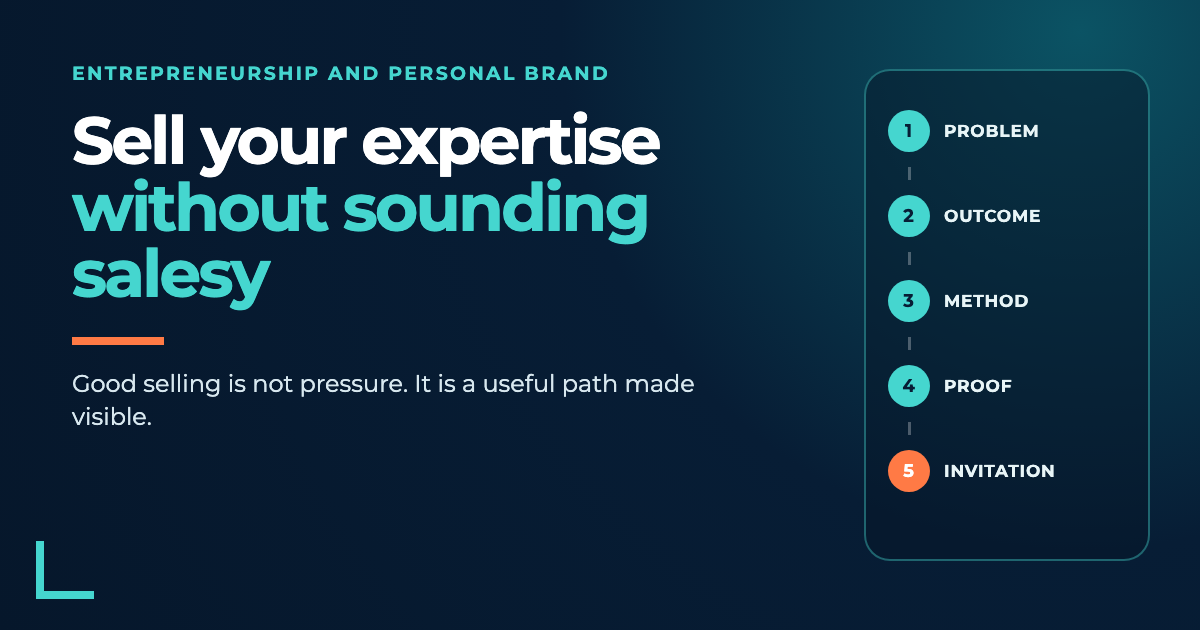
Good selling is not pressure. It is a useful path made visible.
Start with the problem, not your biography
Experts often begin by explaining how much they know.
They list qualifications, years of experience, book titles, speaking topics and everything included in the program. Those things can build credibility, but they are not where the buyer begins.
The buyer begins with a problem.
They may have a team that avoids difficult conversations. They may have a valuable idea but no clear keynote. They may be experienced in their field but invisible in the market. They may know their message but struggle to communicate it in a way people remember.
Name the problem in language they recognise.
Instead of saying, "I deliver transformational communication solutions," say, "I help leaders make important messages clear enough for people to understand and act on."
Specificity is not aggressive. It is helpful.
When people can recognise themselves in the problem, they can decide whether the conversation is relevant.
Define the outcome without making a promise you cannot keep
Once the problem is clear, describe the direction of change.
What will be different after someone works with you?
Be practical. A leader may leave with a clearer communication framework. A speaker may leave with a structured keynote. A business owner may leave with a stronger offer and a more useful way to explain it.
Avoid guarantees you cannot control. You cannot promise that someone will become famous, earn a certain income, secure a particular stage or transform a team overnight.
You can explain what you will help them build, practise, decide or implement.
There is a difference between confidence and exaggeration.
Confidence says, "This is the work we will do."
Exaggeration says, "This result is certain."
Trust grows when your outcome is ambitious enough to matter and honest enough to believe.
Explain your method
Expertise can feel intangible until people can see how it works.
Do not give away every detail, but show the shape of the journey.
If your process has three stages, name them. If your keynote helps an audience move from awareness to decision to action, make that visible. If your coaching begins with diagnosis, moves into practice and ends with implementation, say so.
A method does three important things.
First, it shows that your work is more than inspiration.
Second, it helps people understand what they are buying.
Third, it gives your expertise language that other people can repeat inside their organisation.
That last point matters. The person who likes your work may not be the final decision-maker. Give them a clear way to explain your value to someone else.
Use proof that matches the claim
Proof is not decoration. It helps a buyer reduce uncertainty.
The right proof depends on what you are asking them to believe.
If you claim you can hold a room, show real speaking footage. If you claim your method creates clarity, share a relevant case study or example. If you claim you understand a sector, demonstrate that understanding through the questions you ask and the language you use.
Do not inflate a testimonial. Do not borrow a result from one person and imply that everyone will achieve it. Do not use a famous logo as a substitute for explaining the actual value of your work.
Strong proof is specific, relevant and proportionate.
Sometimes the most credible sentence is simply: "Here is what we did, here is what changed, and here is what remains their responsibility."
That is not weak marketing. That is mature marketing.
Make a clean invitation
Many experts do all the educational work and then disappear at the exact moment a person needs a next step.
They finish a post with no invitation. They end a keynote without explaining what happens next. They make the website so careful that nobody knows how to enquire.
An invitation is not pressure.
It can be as simple as:
"If this is the problem your team is facing, let us have a conversation."
"If you are ready to turn your experience into a clear keynote, enquire about the next step."
"If you want to explore whether this is the right fit, book a short call."
Then make the action easy. Use one relevant link, one clear button or one reply prompt. Do not offer six competing paths.
Clarity respects people's time.
Follow through like the person you said you were
The sale does not end when someone says yes.
Your follow-through is part of your brand.
Respond when you said you would. Prepare properly. Confirm the next step. Make the experience easy to navigate. If something changes, communicate early.
People follow people they trust, and trust is often built in the small operational moments after the exciting conversation.
The proposal, the onboarding email, the calendar invitation and the first delivery experience all confirm or weaken the promise you made.
Professionalism is not separate from influence. It is evidence of it.
Selling is clarity in service of a decision
You do not need to choose between serving and selling.
Done well, selling is part of the service.
Name the problem. Define the outcome. Explain the method. Use honest proof. Make a clean invitation. Then follow through.
You are not trying to convince everyone.
You are helping the right person make a clear decision.
That is how you sell expertise without sounding salesy.
Selling expertise FAQs
How can I sell my expertise without sounding pushy?
Make the problem, outcome and method clear, use relevant proof and offer one simple next step. Clarity helps the right person decide without pressure.
What should an expert explain before making an offer?
Explain the specific problem you solve, the practical change you help create, the shape of your method and the proof that supports the claim.
How do I describe an outcome without overpromising?
Describe what you will help a client build, practise, decide or implement. Avoid guarantees involving income, fame, stages or results you cannot control.
Why is follow-through part of selling?
The proposal, onboarding, calendar invitation and first delivery experience either confirm or weaken the trust created during the sales conversation.