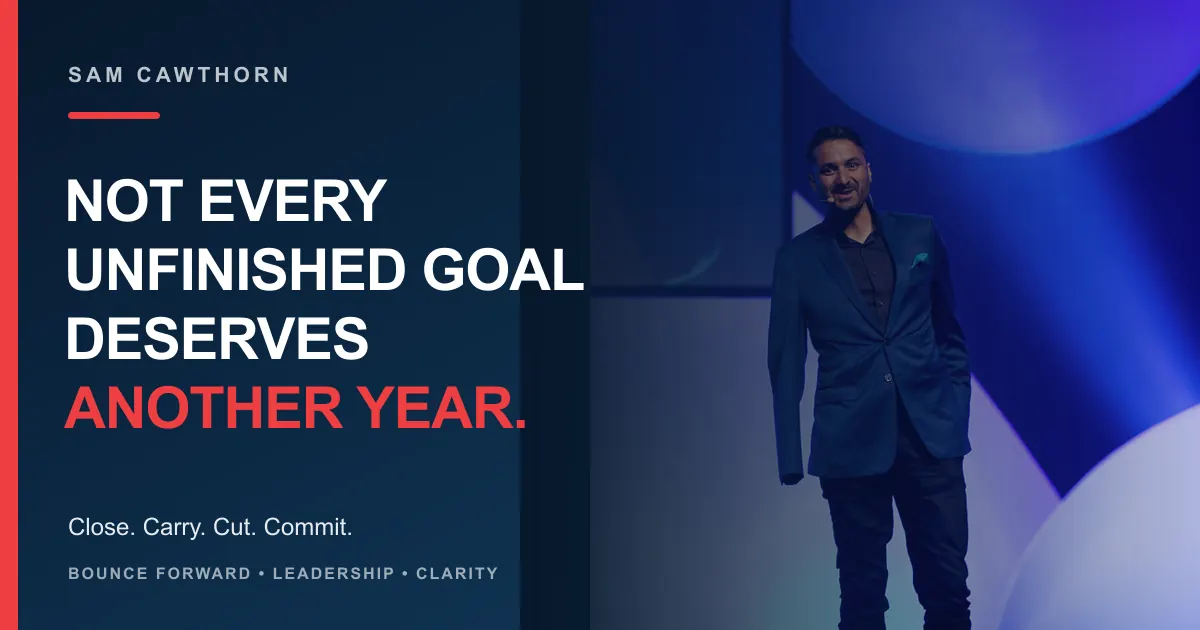
The end of the year has a way of turning every unfinished goal into a verdict.
The book is not finished. The new offer did not launch. The difficult conversation is still waiting. The team did not reach the target. The idea that felt urgent in January is still sitting in a folder.
So we make a familiar promise: next year, I will try harder.
But effort is not always the answer.
Sometimes the goal still matters and needs a better plan. Sometimes the goal has already taught you what it came to teach you. Sometimes it belonged to an earlier version of your life or business. Carrying all three into another year does not create commitment. It creates weight.
I have never believed that moving forward means pretending the past did not happen. Bounce Forward is about using what happened to make a stronger, more intentional choice about what comes next.
That applies to setbacks. It also applies to goals.
Before you write a longer list for the new year, review the one you already have. Use four decisions: Close, Carry, Cut and Commit.
1. Close what is actually complete
Many people finish the year feeling behind because they measure only the original target.
Perhaps you planned to launch a complete program but finished the curriculum, tested two sessions and found the right audience. Perhaps you wanted to write a book but developed the central idea, taught it publicly and discovered which part people found most useful. Perhaps a team missed the final number but fixed the process that had been holding performance back.
That is not the same as doing nothing.
Ask:
- What moved?
- What did we learn?
- What became easier, clearer or more useful?
- What evidence now exists that did not exist at the start of the year?
Closing a goal does not always mean declaring victory. It means naming the result honestly so you stop carrying a false sense of incompletion.
Leaders need to do this visibly. Teams become exhausted when every achievement is immediately swallowed by the next demand. Marking progress helps people understand that their work mattered. It also gives you better evidence for the next decision.
Do not rush past what moved just because it did not move exactly as planned.
2. Carry only what still earns its place
Some goals deserve another season.
The mistake is carrying them forward automatically.
An old goal should have to earn a place in the new year. Ask three questions:
- Does this still matter?
- Is the outcome still relevant to the people I want to serve?
- Am I willing to give it time, attention and a clear next action?
If the answer is yes, carry it forward deliberately. Do not copy and paste it onto a fresh list.
Rewrite it using what you now know.
Maybe the scope was too large. Maybe the deadline ignored another commitment. Maybe you were trying to build before you had listened. Maybe the goal was useful but the method was wrong.
Experience should change the plan.
A goal carried forward without a lesson is just repeated pressure. A goal carried forward with better evidence becomes a stronger decision.
3. Cut what no longer belongs
This is the part most high achievers avoid.
We confuse stopping with failing. We keep projects alive because we have already invested time, money or public enthusiasm. We worry that changing direction will make us look inconsistent.
But there is nothing impressive about protecting a goal that no longer serves the mission.
Some goals were built around an assumption that proved wrong. Some were chosen to impress people who are not living your life. Some were good ideas with the wrong timing. Some became unnecessary because a better opportunity appeared.
Cutting a goal can be an act of leadership.
Say what changed. Keep the lesson. Release the obligation.
You can say:
"This mattered when we began, but the evidence has changed."
"The problem is still real, but this is not the right solution."
"We are ending this project so we can focus on the work that now matters more."
Clarity builds more trust than quietly dragging a dead priority through another planning cycle.
4. Commit to the next visible move
A goal is not a commitment until it changes the calendar.
Once you know what you are carrying forward, name the next visible move.
Not "work on the book."
Choose the chapter question and test it in a conversation.
Not "improve communication."
Schedule the meeting and name the decision that needs to be made.
Not "grow the business."
Speak to five customers and identify the problem they are already trying to solve.
The next move should be small enough to start, meaningful enough to create evidence and clear enough that you know whether it happened.
Momentum rarely begins with a perfect annual plan. It begins when one useful action makes the next decision easier.
Use the four-part year-end review
Take every open goal, project or promise and place it in one of four categories:
Close: What can be acknowledged as complete, learned or resolved?
Carry: What still matters and deserves a revised plan?
Cut: What no longer belongs in the next season?
Commit: What is the next visible action, and when will it happen?
Be honest. A goal should not appear in more than one category.
This is not about lowering your standards. It is about directing your standards toward work that still matters.
When I speak about bouncing forward, I am not asking people to forget the plan they had. I am asking them to stop assuming the old plan is automatically the right destination.
The same principle can change the way you finish a year.
You do not need to drag every unfinished ambition across the line with you. Honour what moved. Learn from what did not. Release what no longer fits. Then make one clear commitment to the future you are actually building.
The goal is not to enter the next year carrying more.
The goal is to enter it carrying what matters.
Year-end goal review FAQs
How do I review unfinished goals at the end of the year?
Put every open goal into one of four categories: Close, Carry, Cut or Commit. Acknowledge what moved, keep only what still matters, release what no longer fits and name the next visible action.
Should I carry every unfinished goal into the next year?
No. Carry a goal forward only when it still matters, remains relevant to the people you serve and deserves a clear investment of time and attention.
When should a leader stop pursuing a goal?
Stop when the evidence has changed, the goal no longer serves the mission, the proposed solution is no longer right or a more important priority now deserves the resources.
What turns a goal into a real commitment?
A goal becomes a commitment when it changes the calendar. Name a specific, useful next action and decide when it will happen.