Most leaders do not have a communication problem because they lack information.
They have a communication problem because they give people information without giving them a picture.
A strategy deck can explain the market. A town hall can announce the decision. An email can list the milestones. But if people still cannot see what the change means for their next meeting, their next client conversation or their next decision, the message has not landed.
This is where Storyshowing matters.
Storytelling can make a message interesting. Storyshowing makes the message visible. It helps people picture the situation, recognise their part in it and understand what action looks like.
When change is communicated badly, people fill the gaps themselves. They wonder what is being hidden, what will happen to their role and whether the leadership team has thought through the consequences. Even a sensible change can lose trust when the communication is abstract, inconsistent or late.
The answer is not to pretend you have certainty that does not exist. The answer is to make the next part clear enough for people to move.
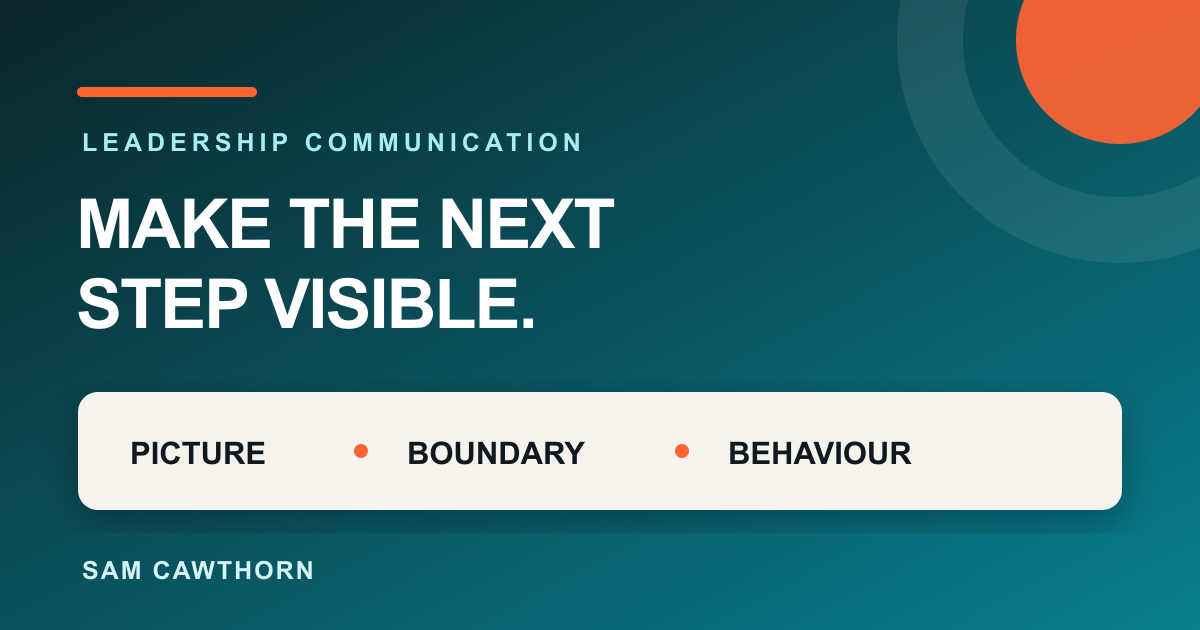
I use a simple three-part test: Picture, Boundary, Behaviour.
1. Picture: show people what different looks like
Leaders often describe change with broad words such as transformation, innovation, efficiency, growth and alignment.
These words may be accurate, but they are difficult to act on.
If you say, "We need to become more customer focused," every person in the room can agree while imagining something different. One person thinks it means faster replies. Another thinks it means more product choice. Another thinks it means saying yes to every request.
A useful picture turns the idea into a moment people can recognise.
Instead of saying, "We need to become more customer focused," try this:
"When a customer raises a problem, the first person who receives it owns the next step. They may not solve it alone, but they tell the customer who is taking it forward and when they will hear back."
Now people can see it.
The picture does not need to be dramatic. It needs to be specific. Show the meeting that will run differently. Show the decision that will be made faster. Show the conversation that will sound different. Show what a customer, colleague or partner will experience when the change is working.
This is one of the biggest lessons I have learned as a speaker. Audiences rarely remember a list of abstract points. They remember a moment they could see and a meaning they could connect to their own life.
Leaders need the same discipline.
Before you announce a change, ask:
What will people be able to see, hear or experience when this is working?
If you cannot answer that clearly, the message is probably not ready.
2. Boundary: say what changes and what does not
Uncertainty expands when leaders leave the edges of a decision blurry.
People need to know what is changing, but they also need to know what is staying the same. Without that boundary, a single announcement can feel much bigger and more threatening than it is.
Be honest about three things:
- What has been decided.
- What has not been decided.
- What is not changing right now.
This protects trust because it separates fact from speculation.
You might say:
"We have decided to change the way client enquiries are assigned. We have not yet finalised every reporting step. Our service promise and the people responsible for client relationships are not changing."
That is more credible than presenting an unfinished plan as complete.
Some leaders avoid this level of honesty because they worry it will make them look uncertain. I believe the opposite is true. False certainty weakens leadership. Responsible clarity strengthens it.
People do not need you to predict every detail. They need you to tell the truth about the detail you have.
The boundary also includes the reason for the change. Do not bury it under corporate language. Name the problem you are solving and why it matters now.
Keep the reason short enough to repeat. If your people cannot explain the change to someone else, they will struggle to carry it into the business.
3. Behaviour: give people one useful action
Communication is not complete when people understand the message. It is complete when they know what to do with it.
This is where many change announcements fall apart. Leaders explain the destination, then finish with a vague request to "embrace the journey" or "get on board."
That is not a call to action.
A strong first action should be:
- small enough to start now
- specific enough to observe
- connected clearly to the change
- owned by a named person or group
For example:
"From Monday, every team meeting will begin with the customer issue that most needs a decision. The team leader owns the agenda change, and the issue owner leaves with a next step and due date."
That behaviour gives the strategy somewhere to live.
Do not overload people with ten actions at once. Movement creates evidence. Evidence builds confidence. Once the first behaviour is working, you can add the next one.
This is also where leaders must model the change personally. If you ask people to simplify decisions while you keep adding approval layers, your behaviour will speak louder than the announcement. If you ask for open feedback but punish the first difficult question, the room will learn that silence is safer.
People follow what leaders reinforce, reward and repeat.
Use the room, not just the microphone
Change communication should not be a one-way performance.
After you share the Picture, Boundary and Behaviour, create space for people to test what they heard.
Ask:
- What feels clear?
- What still feels uncertain?
- Where could this become difficult in practice?
- What support would help you take the first action well?
These questions do not weaken the message. They reveal where the message still needs work.
Listen for patterns rather than defending every sentence. If several people misunderstand the same point, that is communication data. Clarify it. If they identify a real operational risk, own it and decide what happens next.
Then close the loop. Tell people what you heard, what will change because of their input and when the next update will come.
Clarity is a form of care
When people are facing change, they are not only processing a business decision. They are working out what it means for their competence, their relationships, their reputation and their future.
That is why clear communication matters.
You do not have to remove every unknown. You do have to respect people enough to show them the picture, name the boundaries and give them a useful first behaviour.
The goal is not to make change sound exciting.
The goal is to make the next step visible.
Before your next announcement, run the message through the three-part test:
Picture: Can people see what different looks like? Boundary: Do they know what is decided, undecided and unchanged? Behaviour: Do they know what to do next?
If the answer is yes, you are no longer just telling people about change.
You are showing them how to move through it.
Change communication FAQs
How do you communicate change clearly?
Show people what different will look like, state what is decided and still open, then give them one useful action they can start now.
What is the Picture, Boundary, Behaviour framework?
Picture makes the future visible, Boundary separates decisions from unknowns, and Behaviour turns the message into a specific next action.
How should leaders communicate uncertainty?
Be clear about what has been decided, what has not been decided and what is not changing right now. Responsible clarity is stronger than false certainty.
What should happen after a change announcement?
Invite questions, listen for repeated misunderstandings or operational risks, clarify the message and close the loop with the next update and named owners.